
Sell Your Food Processing & Packaging Business — M&A Advisory for Co-Packers, Cold Chain & SQF-Certified Operations
You built a facility defined by throughput, rigorous food safety, and operational excellence; you deserve an advisor who can quantify your technical enterprise value beyond a simple asset appraisal. We bridge the gap between complex floor operations and high-multiple exits by speaking the language of SQF, OEE, and recurring contract revenue.
The 2026 M&A Landscape for Food Processing

Generalist business brokers fail to value the "technical moats" that define food processing, often overlooking the massive CAPEX investments in automated CIP (Clean-in-Place) systems or proprietary formulation processes. In the current market, strategic buyers and private equity "platform" seekers are prioritizing facilities that have mitigated labor volatility through advanced robotics and integrated ERP systems.
Automated Throughput & OEE: Buyers are paying a premium for facilities that demonstrate high Overall Equipment Effectiveness (OEE) and low reliance on manual labor.
Regulatory Compliance Moats: Ownership of SQF Level 3, BRCGS, or specialized Organic/Non-GMO certifications creates an immediate barrier to entry for competitors, driving up valuation multiples.
Contractual Stickiness: Firms with multi-year Co-Packing or Private Label agreements with Tier 1 CPG brands are seeing aggressive bidding wars and shorter due diligence cycles.
Technical Competencies We Represent in Food Processing & Packaging

Aseptic Processing & High-Speed Filling
Focus Area: Microbiologically shelf-stable liquid processing and packaging without refrigeration.
Icon Suggestion: A sealed sterile container with a high-speed motion graphic.
Equipment & Labor: Tetra Pak A3/Flex lines, Krones aseptic filling blocks, and GEA heat exchangers; staffed by thermal process authorities and PLC-certified technicians.
The Buyer Pool: Global CPG conglomerates, Tier 1 beverage co-packers, and PE firms focused on "better-for-you" liquid brands.
Key Certification: FDA Low-Acid Canned Food (LACF) registration and SQF Level 3.

Automated Secondary Packaging & Robotics
Focus Area: End-of-line automation including case packing, palletizing, and vision-system inspection.
Icon Suggestion: A robotic arm manipulating a corrugated case.
Equipment & Labor: Fanuc or ABB delta robots, high-speed case erectors, and integrated X-ray/Metal Detection systems; managed by automation engineers and Mechatronics specialists.
The Buyer Pool: Strategic logistics providers and packaging-heavy PE roll-ups seeking operational synergy.
Key Certification: PMMI membership and ISO 9001:2015.

Cold Chain & IQF (Individually Quick Frozen) Solutions
Focus Area: Advanced cryogenic freezing and temperature-controlled processing for perishable proteins and produce.
Icon Suggestion: A snowflake icon integrated with a conveyor belt.
Equipment & Labor: Spiral freezers (Frigoscandia), ammonia refrigeration systems, and nitrogen tunnel freezers; staffed by ammonia safety (PSM) officers and HACCP coordinators.
The Buyer Pool: Cold storage REITs looking to move upstream and specialized protein processors.
Key Certification: USDA FSIS inspection status and Global Cold Chain Alliance (GCCA) accreditation.

Navigating Industry-Specific Compliance in M&A
FSMA (Food Safety Modernization Act) Preventive Controls
The Problem: Inadequate documentation of Preventive Controls or Hazard Analysis can lead to "Buyer’s Remorse" during due diligence, resulting in massive valuation hair-cuts or deal termination.
The Solution: The Precision Firm conducts a pre-market "Audit Readiness" review, ensuring all PCQI (Preventive Controls Qualified Individual) records are immaculate and ready for a buyer’s quality assurance team.
Environmental & Wastewater Management (BOD/TSS)
The Problem: High Biological Oxygen Demand (BOD) or Total Suspended Solids (TSS) in plant effluent can lead to municipal surcharges or environmental litigation that scares off institutional capital.
The Solution: We quantify the efficiency of your on-site pretreatment systems and model the CAPEX requirements for future-proofing wastewater, turning a potential liability into a manageable operational metric.
Tier 1 Customer Audit History
The Problem: Buyers fear "Customer Concentration Risk" where a single failed audit from a major retailer (e.g., Walmart or Costco) could wipe out 30% of revenue overnight.
The Solution: We present a 3-year "Audit Scorecard" to buyers, demonstrating a consistent track record of high-performance scores, which validates the robustness of the operational team and quality systems.
How We Value a Food Processing & Packaging Business
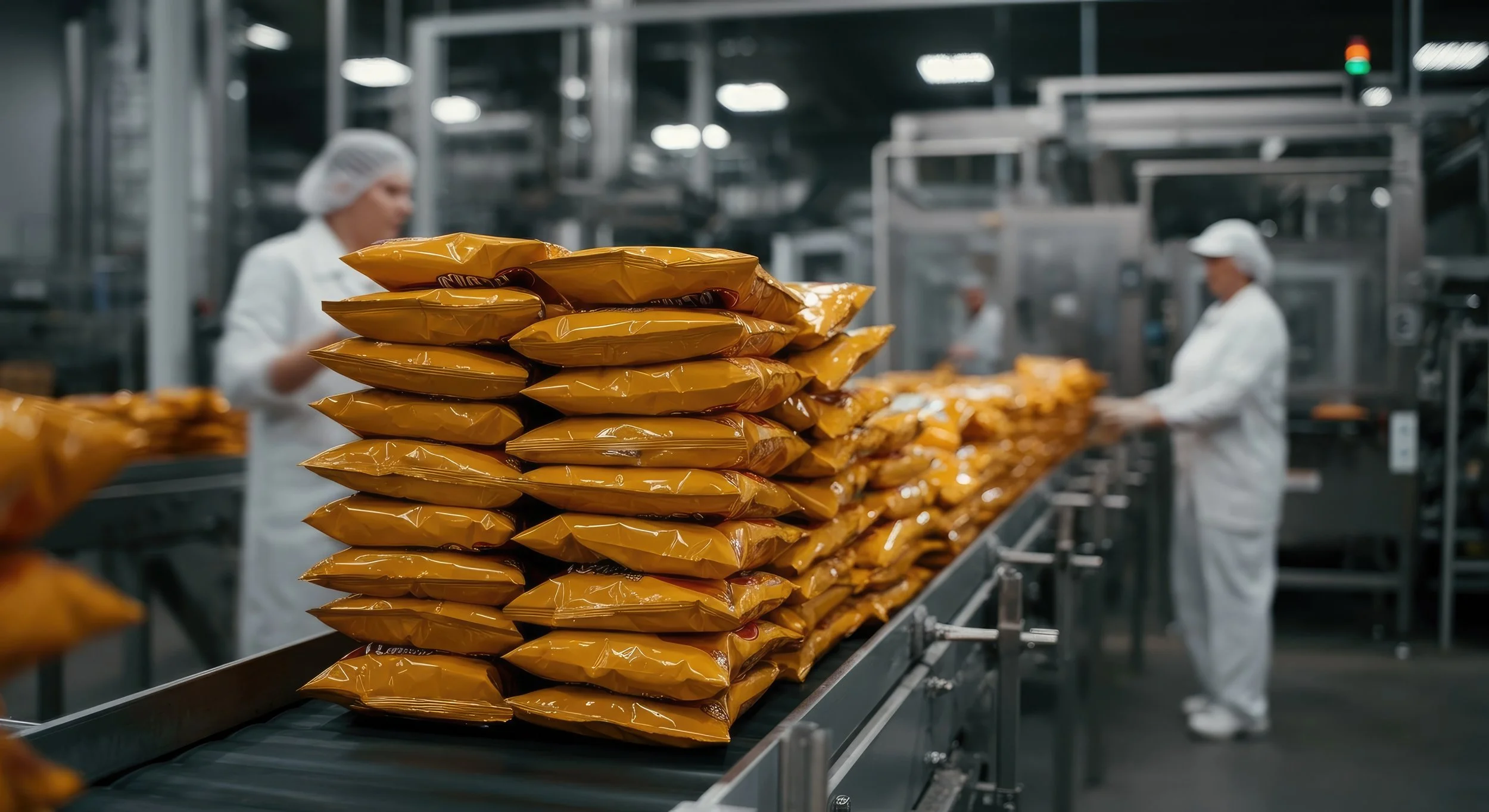
In the food sector, we focus on the Technical Premium. This is the additional value assigned to a business because its assets and certifications are difficult, expensive, and time-consuming to replicate. While a generic machine shop might trade on a simple multiple of trailing twelve months (TTM) EBITDA, a food plant is valued on its replacement cost, its regulatory "moat," and its capacity for scale.
High Barrier to Entry (CAPEX Replacement): New greenfield food plants can take 24 months to permit and build. Buyers pay a premium to "buy time" and acquire an existing, permitted, and operational facility.
Sticky Customer Base: Deeply integrated co-packing relationships involve proprietary formulations and customized lines, making it incredibly difficult for customers to switch vendors.
Scalability through Automation: A facility operating at 60% capacity with high-speed automated lines is worth significantly more than a facility at 90% capacity with manual labor, as the former offers a clear path to EBITDA growth without additional investment.
Frequently Asked Questions: Selling a Food Processing Business
-
A: Food processing businesses are valued at a premium over general manufacturing due to high barriers to entry and non-discretionary demand. While general manufacturing may trade at 4x-6x EBITDA, advanced food processing firms with SQF certification and automated lines frequently command 7x-10x+ multiples depending on their customer mix.
-
A: SQF Level 3 or BRCGS certifications act as a value-multiplier by de-risking the acquisition for institutional buyers. These certifications prove that the business meets the highest global standards for food safety, which is a prerequisite for servicing major retail and national accounts.
-
A: Contract backlog in food processing is treated as secured future cash flow and is a primary driver of the EBITDA multiple. Unlike "project-based" manufacturing, the food industry relies on recurring "runs," and having a signed Master Service Agreement (MSA) with a Tier 1 brand provides the buyer with the certainty required to pay a top-tier price.
-
A: We protect customer relationships by utilizing a "Blind Profile" during the initial marketing phase and withholding specific customer names until an LOI is signed. Our process ensures that your competitors, employees, and customers do not know the business is for sale until it is in the best interest of the deal to disclose it.
-
A: A typical exit for an advanced food processing firm takes between 6 and 9 months from engagement to wire transfer. This timeline accounts for the rigorous "Quality of Earnings" (QofE) and environmental audits that are standard in food-grade facility transactions.
Ready to Maximize the Value of Your Food Processing Business?
The Precision Firm is not comprised of "suits" who stay in the boardroom. We are Former Operators who have managed shift schedules, navigated FDA inspections, and approved million-dollar CAPEX budgets. We understand that your business is more than a spreadsheet—it is a complex ecosystem of machinery, certifications, and human capital.
When you are ready to exit, don't hire a generalist. Hire an advisor who knows the difference between a simple conveyor and an aseptic filling block.